By Tim Seldin
This is an article that will run in the February issue of our Montessori Family magazine, Tomorrow’s Child
Abbie, a Montessori Elementary student, sits absorbed in research about ancient Rome; however, she’s not just memorizing emperors and dates. She’s tracing how volcanic soil made Italian agriculture possible, how that abundance supported urban development, how cities required engineering innovations like aqueducts, how those engineering principles used specific mathematical concepts, and how trade routes connected Rome to cultures across three continents.
By the end of the week, she’s created a timeline, calculated aqueduct angles, mapped trade routes, written about daily life in Pompeii, and presented her findings to classmates who added their own discoveries about Roman influence on modern language, architecture, and government.
This isn’t learning scattered across disconnected subjects. It’s an integrated understanding, and it’s powered by something Montessori parents sometimes underestimate: imagination.
Imagination as Serious Intellectual Work
When adults hear “imagination” in educational contexts, they often think of fantasy, creative play, or a break from rigorous academics. Montessori means something quite different.
In elementary education, imagination becomes a critical intellectual tool—the capacity that allows children to move beyond what’s immediately visible and graspable. It enables them to:
Travel mentally through time. Understanding that the ground beneath their feet once held dinosaurs, that people thousands of years ago faced similar human challenges, that future generations will inherit the world they’re shaping now.
Grasp abstract concepts through narrative. Mathematical principles become vivid when embedded in stories of ancient Babylonian astronomers. Evolutionary biology makes sense through the drama of Earth’s changing conditions.
See relationships rather than isolated facts. Recognizing that geography shapes culture, climate influences agriculture, resources drive conflict and cooperation, ideas spread and transform across boundaries.
Develop genuine empathy. Imagining what life feels like from perspectives radically different from their own.
Dr. Montessori observed that children between ages six and twelve develop a profound hunger to understand how things work and why the world is the way it is. Their imagination—their capacity to mentally inhabit scenarios they haven’t directly experienced—becomes the bridge between concrete experience and abstract understanding.
This isn’t a soft departure from academics. It’s how deep academic engagement becomes possible.
Integration Across Domains
Montessori elementary education doesn’t divide knowledge into isolated subject periods. A typical day doesn’t look like: math 9-10am, history 10-11am, science 11-12pm, each taught independently with separate materials and unrelated content.
Instead, watch what happens when children explore a question like “How did early humans survive?”
They study geography—mapping where different human groups settled, why certain locations offered advantages, and how climate shaped migration patterns.
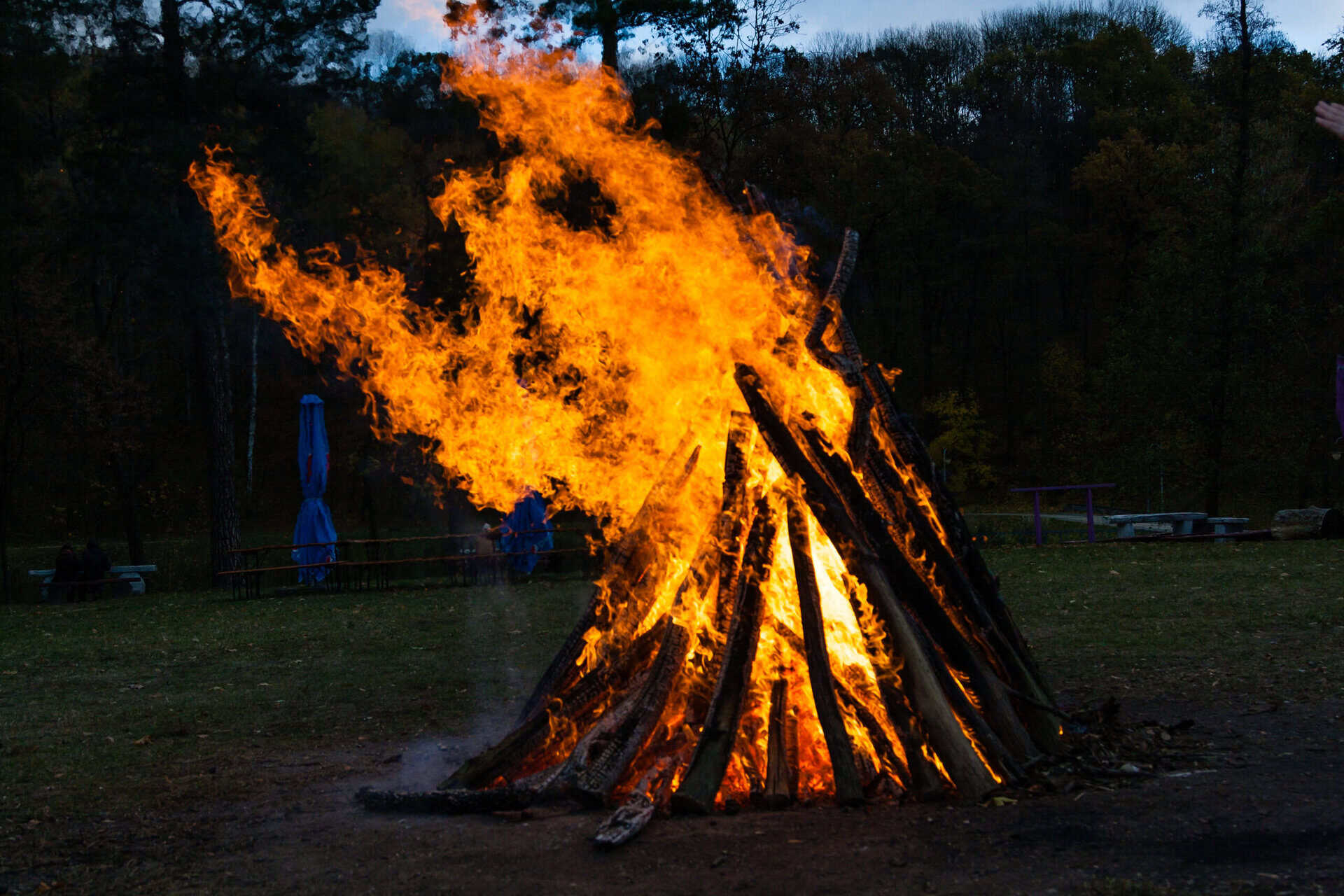
They investigate biology—understanding which plants were edible, how humans learned to hunt cooperatively, and why fire mattered for survival and nutrition.
They explore anthropology—examining how different cultures developed tools, shelter, social structures, and belief systems in response to their environments.
They practice mathematics—calculating distances traveled during migrations, measuring tools, and comparing effectiveness, creating timelines spanning tens of thousands of years.
They develop language—writing narratives, imagining daily life, creating presentations, and learning how language evolves and spreads.
They engage with ethics—considering questions about cooperation, resource sharing, environmental impact, and what makes communities sustainable.
Each thread connects to others. The knowledge becomes coherent rather than fragmented. Children don’t just learn facts—they understand relationships, causes, patterns, and significance.
When parents ask, “What did you learn today?” the answer might be “We’re studying early humans” rather than “We did math and then history and then science.” Because in Montessori elementary, they did all of these simultaneously—and the learning went deeper as a result.
Cosmic Education: The Framework That Holds Everything Together
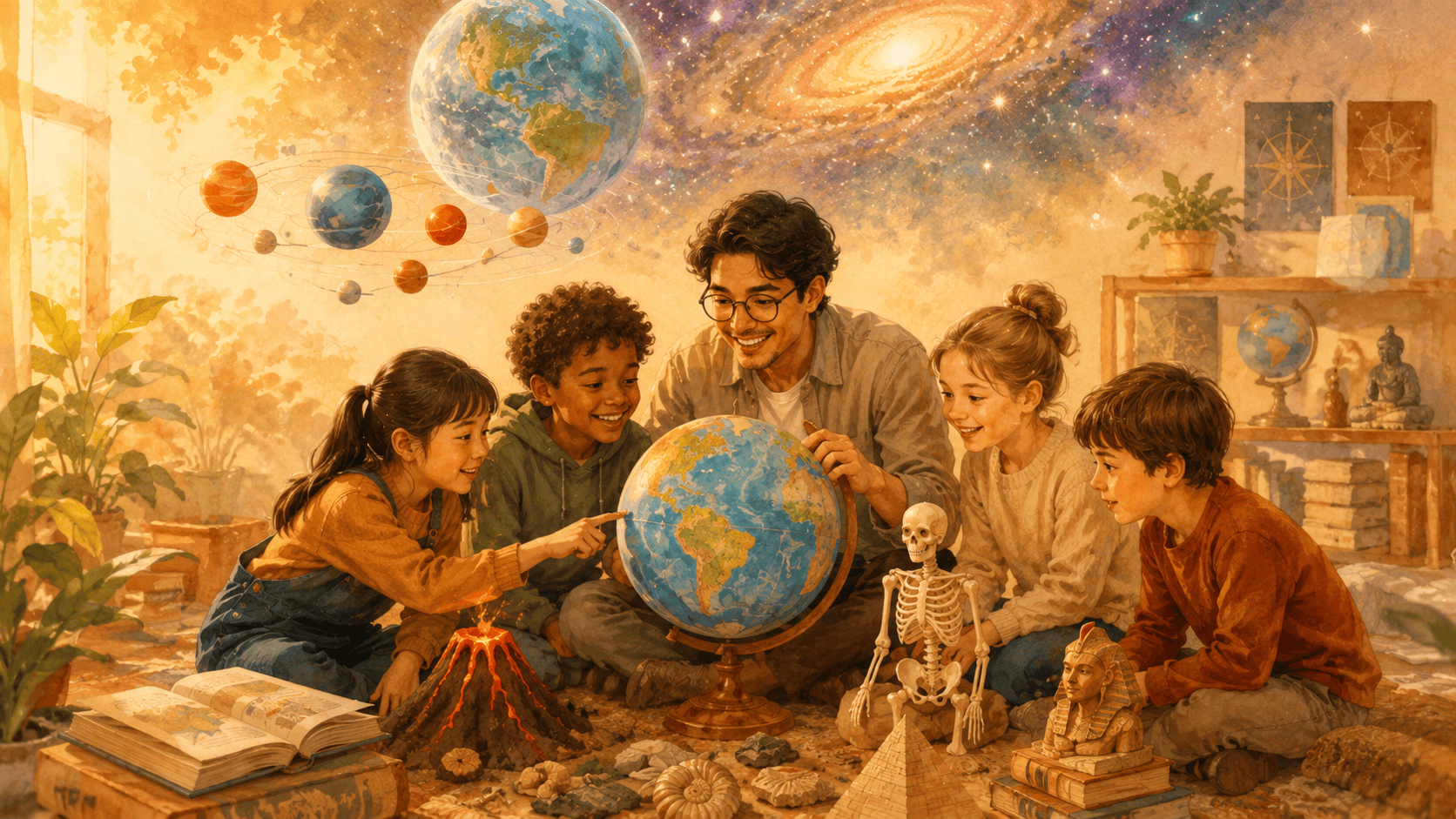
This integration isn’t random or teacher-dependent. It’s built into the framework Montessori called Cosmic Education—an approach suggesting that the universe is an ordered, interconnected whole where every element plays a role. Nothing exists in isolation. Everything has a function within larger systems.
The curriculum begins with five Great Lessons—narrative-driven explorations that children experience together:
- The Story of the Universe – How matter, stars, and our solar system formed
- The Timeline of Life – How life emerged and evolved on Earth
- The Coming of Humans – How humans developed and spread across the planet
- The Story of Writing – How humans learned to record and share ideas
- The Story of Numbers – How humans developed mathematical thinking
These aren’t lessons to memorize. They’re invitations to wonder—launching points for months of investigation.
Consider what happens after children experience the Story of the Universe. The guide presents dramatic demonstrations: chemical reactions showing how early elements formed, experiments with states of matter, and visualization of cosmic time scales. Children watch in wonder as substances combine, transform, and release energy. The presentation ends with Earth’s formation—a ball of molten rock gradually cooling, developing layers, beginning the long process of becoming habitable.
One child becomes fascinated by volcanoes. How do they work? Why do they exist? She begins researching, discovers plate tectonics, learns that volcanic soil is incredibly fertile, and traces how this affected where civilizations developed. She’s now connecting geology to agriculture and human settlement patterns—following her curiosity across multiple domains while the guide ensures she encounters rigorous content at each turn.
Another child fixates on the timeline itself. Billions of years compressed into a single narrative. He wants to understand these scales mathematically, create proportional timelines, discover exponential notation, grasps why scientists use different measurement units for cosmic versus human time.
A third investigates meteors and asteroids, leading to the study of impact craters, which connect to extinction events, which raise questions about what happened to the dinosaurs, which opens the entire field of paleontology.
Everything connects back to the big story. When children study ancient Egypt, they understand it as part of human development, shaped by specific geographic conditions. When they explore fractions, they see them as tools humans invented to solve practical problems. When they learn about current events, they have context for understanding why conflicts emerge and how cooperation develops.
This framework does something profound: it helps children see themselves not as isolated individuals accumulating random information, but as participants in an ongoing story they’re helping to shape.
Why Cultural Studies Feel Different
In conventional curricula, cultural studies are often superficial—special “multicultural weeks” where children sample foods, learn a few facts about holidays, and move on. The underlying message is often: “These people are different and far away.”
Montessori’s approach is fundamentally different because cultures aren’t studied as exotic curiosities but as human responses to specific conditions.
Children investigating Japanese culture discover how island geography, volcanic activity, limited land for agriculture, and typhoon frequency shaped everything from architecture to diet to social organization to values.
They learn that traditional Japanese buildings use flexible wooden frames that sway during earthquakes rather than rigid structures that crack and collapse.
They understand why Japanese cuisine centers on seafood and rice—abundant resources in that environment—and why presentation and efficient use of space matter in a culture where land is precious.
They see how the necessity of cooperation for survival in a disaster-prone environment influenced social values around group harmony.
They’re not learning that Japanese people are mysteriously different—they’re understanding that human beings everywhere develop ingenious solutions to the specific challenges their environment presents.
This makes contemporary global issues far more comprehensible. When children study the Middle East, they already understand how geography and climate shape human needs. When they encounter discussions about rainforest preservation, they’ve studied how ecosystems function and why biodiversity matters. When they hear about refugee movements, they’ve explored human migration throughout history.
The result isn’t just knowledge about other cultures—it’s genuine curiosity, respect for human ingenuity across contexts, and understanding that beneath surface differences lie shared human needs and remarkable adaptability.
Imagination and Ethical Development
Montessori believed imagination serves not just intellectual development but moral growth. When children can mentally inhabit another person’s experience—across time, distance, or circumstance—empathy becomes possible.
A group of students studying indigenous peoples of the Pacific Northwest becomes fascinated by sophisticated resource management—how these communities harvested salmon for thousands of years without depleting populations, rotated gathering areas to allow regeneration, and managed forests through controlled burns that prevented catastrophic wildfires.
One student asks: “Why don’t we do this anymore?”
The question opens a genuine ethical inquiry. The children investigate what changed with European contact, how different economic systems valued resources differently, what was lost when traditional ecological knowledge was dismissed. They’re wrestling with real questions: What responsibilities do we have toward the environment? What can we learn from these approaches? Who gets to decide how resources are used?
Another group researching the Industrial Revolution traces how textile machinery transformed production. They’re impressed by the engineering ingenuity—until they learn about child labor in factories, workers losing fingers to machines, entire communities disrupted as traditional crafts became obsolete.
Now they’re grappling with complexity: Innovation creates abundance but also displacement. Progress benefits some while harming others. Technology is powerful but not neutral.
These aren’t abstract moral lessons taught separately from content. They emerge organically from studying real human history, actual environmental systems, and genuine cultural exchange. The children develop what Montessori called “cosmic consciousness”—awareness that their choices have consequences extending beyond themselves, that they’re part of interconnected systems, and that knowledge brings responsibility.
What This Prepares Children For
Some parents worry: Does this imagination-driven, integrated approach actually prepare children for the real academic demands they’ll face—standardized tests, traditional secondary schools, college?
The evidence suggests yes, and then some. Montessori elementary students consistently perform well on conventional assessments because they’ve developed something more valuable than memorized procedures: genuine understanding of underlying concepts. When they encounter a math problem, they don’t just apply a formula—they understand why the formula works. When they read complex texts, they naturally make connections across domains because that’s how they’ve learned to think.
But the preparation goes deeper. These children enter secondary education with:
The ability to think in systems. They naturally ask “How does this connect to that?” rather than seeing isolated problems.
Genuine research skills. They know how to pursue questions, evaluate sources, revise understanding as they discover new information.
Comfort with complexity. They don’t expect simple answers because they’ve learned that interesting questions rarely have them.
Intrinsic motivation. They study because they want to understand, not just to earn grades.
Long-term perspective. They can imagine how today’s actions shape future conditions
.
These aren’t just nice qualities. They’re exactly what’s needed for navigating an increasingly complex, interconnected world where problems don’t respect subject boundaries and solutions require understanding relationships between systems
.
What Parents Should Look For
If you’re wondering whether this integrated, imagination-driven approach is working for your child, shift your attention from conventional metrics to deeper indicators:
The questions your child asks. Are they wondering why civilizations developed where they did, how mathematical concepts were discovered, and what if history had unfolded differently? Curiosity sustained over time matters more than correct answers produced on demand.
Their ability to make connections. Do they spontaneously relate something they learned about ancient Rome to current architecture? Link climate patterns to agriculture to population distribution? This transferring of understanding across contexts shows genuine learning.
The depth of their projects. Are they pursuing topics over weeks, revising their understanding as they discover new information, and integrating knowledge from multiple domains? Sustained investigation develops capacities that brief units never can.
Their engagement with current events. When news mentions conflicts, innovations, or environmental challenges, do they have meaningful context for understanding what’s happening? Can they ask informed questions rather than just absorbing headlines?
Their sense of wonder. Do they still find the world fascinating rather than merely completing required assignments? Intellectual aliveness at this age predicts lifelong learning better than any test score.
These indicators reveal that imagination is doing its serious academic work—building frameworks for understanding that will serve them throughout life.
The Longer View
Montessori elementary education can look deceptively unstructured to parents accustomed to traditional curricula. There may be fewer textbooks, less homework, fewer tests assessing isolated skills. But what’s happening is more ambitious than conventional schooling typically attempts: children are constructing coherent understanding of how the world works.
They’re not memorizing disconnected facts to be recalled on command and quickly forgotten. They’re building intellectual frameworks that help them interpret new information, understand complex situations, and see themselves as capable participants in ongoing human work.
The approach trusts something profound: that children who understand why things matter will work harder and learn more deeply than children simply told what they must know. That imagination properly engaged becomes rigorous thinking. That integration reflects how the world actually works, and fragmentation is the artificial construct.
The work may look different from what you experienced in school. But the minds being shaped are exactly what our world needs: curious, connected, capable of thinking across boundaries, and eager to understand and contribute.
When your child comes home talking about volcanoes and ancient civilizations and mathematical patterns and ecosystems all in the same breath, resist the urge to worry that learning seems scattered. They’re not scattered—they’re learning the way humans actually think when we’re trying to understand something that matters. And that capacity to see connections, pursue questions, and build understanding across domains may be the most valuable education we can offer.
Source : Tim Seldin on LinkedIn